
Table Saw Blades Explained: Tooth Count, Kerf, and Cut Quality
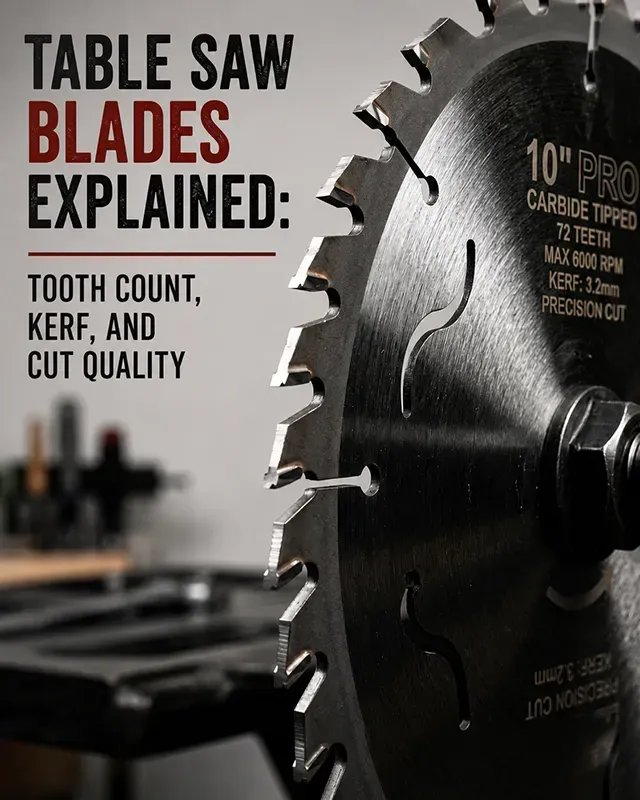
A lot of woodworkers spend months researching table saws, agonizing over fence designs, cast iron extensions, and motor horsepower. But when the saw finally arrives, they throw on whatever stock blade came in the box and wonder why their oak boards are burning or their plywood looks chewed up on the edges.
The truth is, even an expensive cabinet saw will struggle with a dull or mismatched blade. Conversely, a modest jobsite saw paired with the right blade for the material can often produce cleaner, more controlled cuts than its stock blade would suggest. The blade is where the motor’s power meets the wood fibers, making it one of the most important variables in any table saw setup.
We are bypassing manufacturer marketing claims about “laser-cut perfection” and breaking down the raw mechanical design of 10-inch table saw blades. Understanding how tooth count, kerf, grind geometry, and hook angles interact allows you to stop guessing and buy the right tool for your specific saw and projects. The goal is not to find one “best” table saw blade for every shop. The goal is to match blade geometry to the cut: ripping, crosscutting, plywood, MDF, hardwood, or general-purpose work.
INFO
Evidence Level: Level 0 — Mechanics Foundation
This guide explains table saw blade behavior based on tooth geometry, kerf width, hook angle, and material interaction. It does not rank specific blade models or claim measured performance differences between brands. Model-specific recommendations would require separate testing, documented specifications, or repeatable cut-quality measurements.
Tooth Count and Cut Types: The Core Tradeoff
Choosing a blade starts with a fundamental balance: speed versus cleanliness. A blade cannot plow through thick hardwood at high speed and leave a polished, tear-out-free edge at the same time. The mechanics of the cut dictate what works.
Tooth count alone does not determine cut quality. A sharp, well-tensioned 40T blade with stable plate geometry can outperform a cheap 80T blade that vibrates, heats up, or loses tracking under load. However, the main blade categories exist because ripping, crosscutting, plywood, and abrasive sheet goods stress the teeth in different ways.
Rip Blades (Typically 24 Teeth)
When you cut wood along the grain (ripping), you are essentially peeling long, stringy bundles of wood fibers apart. This produces large, bulky shavings rather than fine sawdust.
To handle this, a dedicated ripping blade uses fewer teeth and large gullets—the deep valleys between the teeth. The large gullet acts as a storage bin, clearing those long shavings out of the cut before they can jam. If you try to rip thick lumber with a high-tooth-count blade, the small gullets can fill quickly, friction builds, heat rises, and you end up with burn marks and a struggling motor.
Crosscut Blades (Typically 60 to 80 Teeth)
Cutting across the grain is a completely different mechanical challenge. Instead of peeling fibers apart, you are severing them perpendicular to their length. It is like trying to cut across a bundle of drinking straws; if you aren’t clean, the straws crush and splinter.
Crosscut blades use 60 to 80 teeth to deliver thousands of tiny, precise shears per minute. The gullets are intentionally small because crosscutting produces fine, powdery dust that is easy to clear. The high tooth count ensures that as one tooth exits the wood, the next is already entering, preventing the wood fibers from vibrating and blowing out on the back face of your workpiece.
Combination Blades (Typically 40 to 50 Teeth)
The combination blade is the classic compromise. Most traditional combination blades use grouped tooth patterns, commonly referred to as an ATBR (Alternate Top Bevel + Raker) configuration. These typically feature groups of five teeth: four ATB teeth designed to shear fibers followed by one flat FTG raker tooth designed to clean out the bottom of the cut, all separated by a slightly larger gullet.
In a small workshop, a 40-tooth or 50-tooth blade saves you from swapping blades every time you switch from ripping a board to crosscutting it to length. Just know the compromise going in: it will not rip as fast or as effortlessly as a dedicated 24T blade, and it will not leave as pristine an edge on delicate veneer plywood as an 80T crosscut blade.
Kerf Width vs. Motor Power
Kerf refers to the thickness of the carbide teeth—essentially, the width of the slot the blade leaves behind in the wood. On a standard 10-inch table saw blade, you generally choose between two standard profiles.
- Full Kerf (1/8 inch / 0.125”): The traditional heavier-duty format. Thick, stable, and highly resistant to deflection under heavy loads. It is best matched with stronger hybrid or cabinet saws.
- Thin Kerf (3/32 inch / 0.094”): Removes less wood per cut, creating a narrower channel. This design is often better for 15A jobsite and lower-powered contractor saws.
A thin-kerf blade removes about 25% less material per pass than a full-kerf blade, assuming similar tooth projection and cut depth. That usually translates into noticeably lower cutting resistance, which matters most on smaller motors. On many portable 15-amp jobsite saws, a full-kerf blade can increase resistance enough that the motor slows, heat builds, or the cut quality drops—especially in thick hardwood. The tradeoff is stiffness: a thinner plate has less lateral stiffness, so poor feed control, dense stock, or an unstable setup can show up as slight deflection or surface ripple.
CAUTION
Riving Knife Note: Kerf width also has a safety and compatibility side. The blade kerf should be wider than the riving knife or splitter, while the blade plate should be thinner than the riving knife. If you switch to a very thin-kerf blade, check your saw manual and riving knife thickness before cutting. A mismatch can pinch the stock behind the blade and increase the chance of kickback.
Tooth Geometry and Grind Types
Look closely at the very tips of the carbide teeth, and you will see they are sharpened at distinct angles. These shapes, or grinds, dictate how the tooth attacks the wood fibers.
FTG (Flat Top Grind)
The teeth are ground completely flat across the top, perpendicular to the blade plate. They act like tiny wood chisels plowing through the material. Because they attack the wood squarely, they are incredibly efficient at removing waste, making this the standard geometry for dedicated ripping blades. They also leave a perfectly flat-bottomed groove, which is exactly what you want if you are cutting splines, tenons, or shallow grooves where the bottom is visible.
ATB (Alternate Top Bevel)
The teeth alternate, with one sloping to the left and the next sloping to the right. This creates a sharp point on the outer edge of each tooth, acting like a knife wall scoring the wood fibers ahead of the cut. ATB is the common choice for clean crosscuts and for reducing veneer tear-out on plywood. The sharper the angle (often called High-ATB), the cleaner the cut, though these very sharp points tend to wear down slightly faster over time.
TCG (Triple Chip Grind)
This design alternates between a flat “raker” tooth and a slightly higher tooth with chamfered corners. The chamfered tooth roughs out the center of the cut, and the flat tooth cleans up the edges. TCG is less common for general solid-wood work because it prioritizes durability over ultra-clean fiber shearing. It is excellent for dense, abrasive materials like MDF, laminate flooring, or non-ferrous metals that would dull an ATB blade in a matter of minutes.
Hook Angle: Aggressive vs. Controlled Feeding
The hook angle is the amount of forward or backward lean each tooth has relative to the center of the blade plate. Think of it as how aggressively the tooth bites into the material.
- High Positive Hook (15° to 20°): The teeth lean sharply forward, acting like claws that aggressively hook and pull the wood into the blade. This design makes fast ripping easy on a table saw because it reduces the feeding effort required by the operator. However, a more aggressive hook angle does not automatically mean faster production. Excessive self-feeding increases the chance of inconsistent feed pressure and can contribute to kickback if the stock twists or closes around the blade.
- Low or Negative Hook (0° to -5°): The teeth lean straight up or slightly backward, creating a gentle, scraping action. This is crucial for sliding miter saws and radial arm saws, where an aggressive positive hook can cause the blade to “climb” up onto the wood, pulling the saw head violently toward your hands. On a table saw, a low hook angle is sometimes used on specialty plywood or laminate blades to slow down the feed rate and minimize top-face chipping.
Summary: Matching Blade to Machine and Material
You do not need a storage rack filled with ten highly specialized, expensive blades to get clean results. For most woodworkers, matching the blade to your specific saw motor and primary material type covers almost every task while keeping changeover frustration to a minimum.
| If your saw is… | And you are mostly cutting… | Start with… |
|---|---|---|
| 15A Jobsite Saw | General shop cuts, pine, construction lumber | 40T thin-kerf combination blade |
| 15A Jobsite Saw | Thick ripping, hardwood, rough lumber | 24T thin-kerf rip blade |
| Contractor / Hybrid Saw | Mixed hardwood, plywood, shop projects | 40T or 50T combination blade |
| Cabinet Saw / Strong Hybrid Saw | Heavy hardwood furniture, rough lumber | 24T full-kerf rip blade + 60T–80T crosscut blade if finish quality matters |
| Plywood-Heavy Setup | Plywood, veneers, pre-finished sheet goods | 60T–80T ATB or Hi-ATB blade |
| Laminate / MDF-Heavy Setup | MDF, laminate flooring, melamine, abrasive sheet goods | TCG blade |
For many hobby and small-shop setups, blade selection can deliver a more immediate improvement in cut quality than moving up one class of saw. Once you understand these mechanics, choosing the best table saw blade stops being a brand decision and becomes a matching problem between blade geometry, motor power, and material.
What Specifications Cannot Tell You
Blade specifications explain the direction of the tradeoff, but they do not fully predict real-world cut quality. Carbide brazing quality, plate tensioning, flatness, expansion-slot design, sharpening consistency, and vibration damping vary by manufacturer and price tier. Those differences cannot be quantified from tooth count, kerf width, and hook angle alone.
Thin-kerf behavior is also context-dependent. The point where a thin plate begins to deflect depends on wood species, cut depth, feed pressure, blade sharpness, arbor stability, and whether the stock is well supported. That requires physical measurement, not just spec-sheet analysis.