
Table Saw Jigs: The 3 Essential Setups for a Small Shop
Most table saws you buy retail are built for rough framing first. They rip plywood sheets and chop 2x4s fine out of the box, but the moment you try to do anything requiring tight tolerances, you run into the physical limits of a cheap machine. Cheap contractor saws are particularly bad about this.
The biggest problem is usually the factory miter gauge. Most of them have so much sloppy side-to-side play inside the miter slot that they are practically useless for fine joinery.
That’s where table saw jigs come in. They bridge the gap between a basic construction tool and a precision machine.
But if you spend ten minutes browsing woodworking forums or YouTube, you’ll think you need to build twenty different complex plywood contraptions just to get started. You don’t. In a small garage shop where space is tight and everything gets covered in dust anyway, you only need a couple of basic setups to handle almost everything.
📊 Summary of the 3 Essential Table Saw Jigs
Before we dive into the details, here is a quick overview of the only three jigs you actually need to build for a small workshop:
| Jig Type | Primary Purpose | Build Difficulty | Key Benefit | Recommended Material |
|---|---|---|---|---|
| Crosscut Sled | Precise 90-degree and miter crosscuts | Medium | Completely eliminates miter gauge slop & play | Baltic Birch Plywood & UHMW Runners |
| Tapering Jig (Shop-Made) | Cutting angled legs for tables/chairs | Easy | Much safer & more stable than commercial metal arms | Plywood Carrier & Heavy-Duty Toggle Clamps |
| Straight-Line Ripping Jig | Straightening bowed or rough-sawn boards | Very Easy | Saves space & cost of buying a dedicated jointer | Dead-straight MDF/Plywood runner & Clamps |
1. The Crosscut Sled
This is the one jig you actually need. Build it first.
I remember trying to build a small walnut cabinet years ago using just the stock miter gauge that came with my old contractor saw. Every single mitered corner had a tiny, frustrating gap because the gauge would shift a fraction of a millimeter mid-cut.
A decent crosscut sled fixes that by using two runners that ride in both miter slots at the same time, which completely kills that slop. It carries the wood past the blade while supporting it on both sides of the kerf.
Aside from the accuracy, it’s a massive safety upgrade. Your hands stay well away from the spinning teeth, and the wood is held flat against a solid rear fence so it can’t twist.
TIP
Workshop Space Tip: The only real downside to a crosscut sled is storage. A good 24-inch sled is heavy, bulky, and takes up a lot of wall space in a small shop. However, the absolute precision and safety it offers makes it well worth the storage hassle.
2. Tapering Jigs: Shop-Made vs. Commercial Aluminum
If you need to cut angled legs for a table or chair, you need a way to hold the workpiece at an angle while feeding it through the saw in a straight, controlled path. That is the basic job of a table saw taper jig. The important question is not only whether the jig rides against the fence or in the miter slot, but whether the workpiece is positively restrained during the cut.
Personally, I’ve tried a few over the years and never really trusted them. Those little thumbscrews have a nasty habit of vibrating loose right in the middle of a pass because of motor vibration. Once that happens, the angle shifts, the wood binds, and your expensive lumber is ruined.
CAUTION
Safety Hazard: When a tapering jig’s thumbscrews vibrate loose, the wood can instantly bind against the blade, creating a severe kickback hazard.
A simple shop-made plywood carrier board with a couple of heavy-duty toggle clamps is almost always a better choice:
- No fancy dials needed: You just mark your cut lines directly on the wood, align those marks with the edge of your plywood base, and clamp it down tight.
- Rock-solid stability: Run the straight edge of the jig right against your rip fence. Because the wood sits completely flat on a solid wooden base rather than suspended between metal arms, it just feels a lot more secure.
- One caveat: Just make sure the plywood you use for the base isn’t already warped from sitting in a damp garage.
3. The Straight-Line Ripping Jig
This is a lifesaver if you work out of a small shop and don’t have the space or cash for a dedicated 8-inch jointer machine.
If you try to run a rough-sawn board with a wavy, bowed, or live edge directly against your standard table saw fence, it’s going to rock. The moment that wood shifts and binds against the back of the blade, the teeth will catch it and launch it back at your chest.
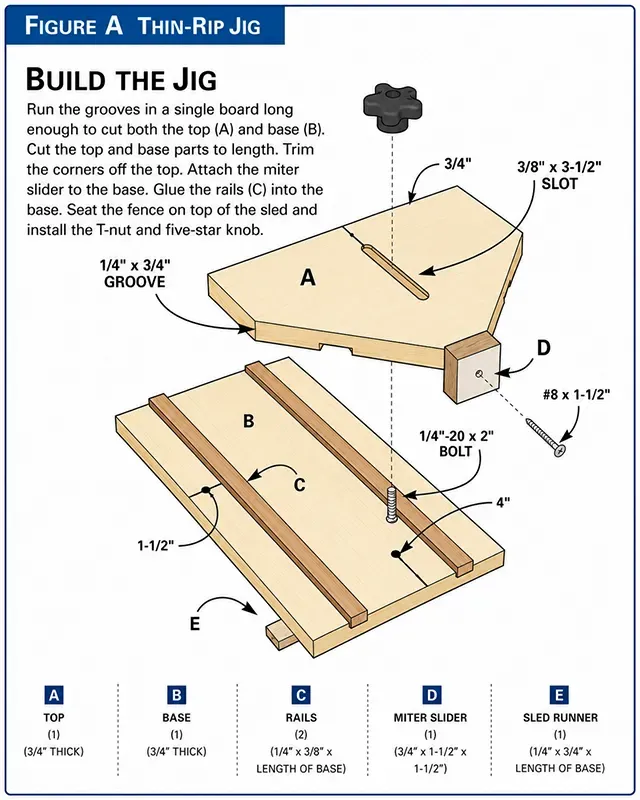
A ripping jig is just a long, dead-straight piece of plywood or MDF with a few clamps.
- Secure the crooked board onto the plywood runner with the bad edge hanging off slightly.
- The rip fence finally has something perfectly straight to ride against instead of that wavy edge on that first cut.
- Once that’s done, you can take the board off the jig, flip it around, and rip the other side normally using just the regular fence.
⚠️ The Catch: Humidity and Slippage
While jigs make things safer by keeping your hands away from the blade, a poorly built one introduces its own set of hazards. If a jig fails or binds mid-cut, it usually results in instant kickback.
The two biggest issues you need to watch out for are runner binding and workpiece slippage:
Runner Binding
If you make your runners out of solid hardwood like maple or oak, they will react to humidity swings in a cold garage. A runner that glides perfectly in October might swell in July, binding tightly inside the miter slot.
You can usually hear the runner start dragging or squeaking inside the slot before it fully jams up. I’ve seen plenty of people fight the saw instead of fixing the jig, but if it stalls mid-cut, your natural instinct is to push harder. That’s exactly how slips happen.
It’s much better to use stable materials like:
- High-density polyethylene (UHMW) plastic runners.
- High-grade Baltic birch plywood sealed with a lot of paste wax to keep the moisture out and stop dust from gumming up the slots.
Workpiece Slippage
I ruined a beautiful piece of walnut years ago because a flimsy plastic hold-down slipped halfway through a taper cut. The wood twisted into the back of the blade, and it launched the offcut right past my shoulder.
Do not skimp on holding power here.
- Stick to heavy-duty metal toggle clamps.
- Always glue a strip of 120-grit adhesive sandpaper to the base of the jig to give the wood some real mechanical grip so it can’t slide around.
📌 The Verdict
Most small shops only need a good crosscut sled and a ripping jig anyway. You can build half your projects with just those two setups.
Don’t waste your time or storage space building every complex plastic or plywood gadget you see online. Start with a solid, square sled to handle your precision crosscuts, and only build a specialized jig when an actual project sitting on your bench requires it. Half the fancy jigs people build end up collecting dust after two projects anyway.