
Evaluating Table Saw Sled Plans: What Actually Works in a Small Shop
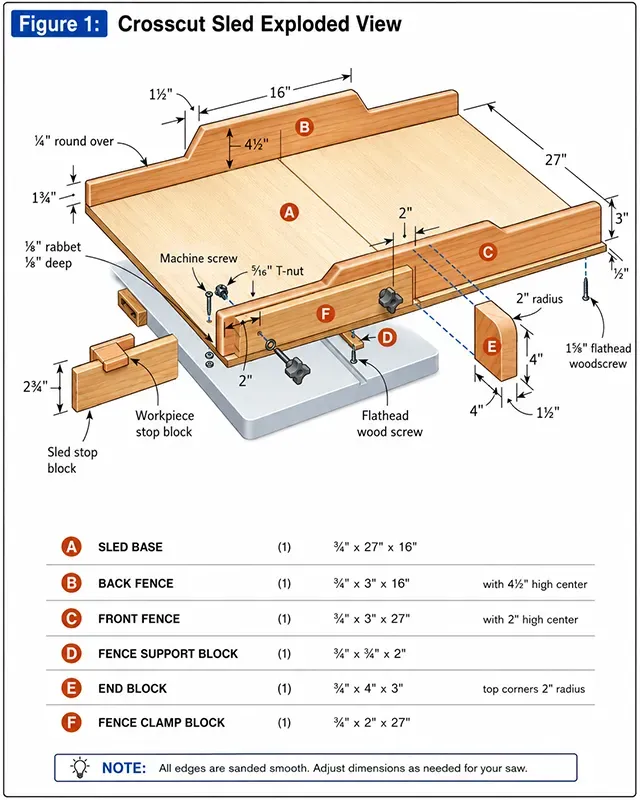
If you spend any time looking for table saw sled plans online, you’ve seen the absolute monsters. They feature double-thick fences, integrated T-tracks running in every direction, and massive bases made from two sheets of heavy plywood. They look great in a well-lit video production where someone has a 2,000-square-foot commercial space.
But if you’re working out of a small garage or a basement, building one of these massive jigs is usually a mistake.
A crosscut sled that weighs 30 pounds is a chore to lift and a nightmare to store. If it’s too heavy or awkward to hoist onto a wall hook, you won’t use it. You’ll end up using a sloppy stock miter gauge instead just to avoid the hassle.
Before you burn through an expensive sheet of Baltic birch, you need to know how to filter out the bad blueprints from the designs that actually make sense for a one-person shop.
📊 Monster Sled vs. Small Shop Sled Plans
Here is a quick breakdown of what to look for—and what to avoid—when selecting a blueprint:
| Design Feature | Monster Sled Plan (Avoid ❌) | Small Shop Sled Plan (Choose ✅) |
|---|---|---|
| Base Material | Double-thick 3/4” MDF or Plywood (Heavy) | Single 1/2” or 5/8” Baltic Birch (Light & stable) |
| Runner Material | Shop-ripped hardwood (swells and binds) | UHMW plastic or adjustable aluminum (stable year-round) |
| Calibration | Framing square & permanent wood glue | 5-cut method calibration (screws-only assembly) |
| Safety Features | Flush and exposed blade exit fence | Thick safety guard block (Visual “no-hands” zone) |
| Weight & Storage | 30+ lbs (Awkward, gathers dust on floor) | Under 10 lbs (Easy to hang on a wall with one hand) |
1. The Trap of the “Monster Sled”
Many free plans prioritize sheer mass over portability. A thick, beefy base sounds like a good way to prevent warping, but regular 1/2-inch or 5/8-inch Baltic birch is more than stable enough for a standard shop sled.
When you add double-thick hardwood fences and endless aluminum tracks, the weight skyrockets. In a small shop where tools have to be put away to make room for cars or other projects, storage dictates everything. If a plan doesn’t naturally allow for a simple storage hole to hang the unit on a wall or the side of your saw cabinet, it’s going to end up sitting on the floor gathering dust and getting kicked.
Keep it light enough to handle with one hand. You want to be able to grab it, drop it in the slots, make your cut, and hang it back up without feeling like you just did a workout.
2. The Runner Material Dilemma: Why Wood Fails
A common recommendation in basic woodworking plans is to rip down scrap pieces of hardwood—like oak or maple—to create the runners that slide in your table saw’s miter slots. It sounds traditional and cost-effective, but it introduces a frustrating mechanical flaw.
Wood movement never really stops, especially in an unheated garage shop.
A hardwood runner that slides beautifully in the dry air of January will almost certainly swell and bind up inside the slot come July. Then you spend half an hour sanding it down just to get it to move. Fast forward back to winter: that same runner has shrunk, introducing side-to-side play (slop) that completely ruins your cutting accuracy.
TIP
Runner Recommendation: Look for plans that specify UHMW (Ultra-High-Molecular-Weight) plastic or adjustable aluminum runners. These materials don’t care about the weather or humidity swings. They don’t swell, they don’t shrink, and they provide a smooth, consistent slide year-round without requiring constant tuning.
3. The Calibration Protocol: Avoid the Permanent Fence Trap
A lot of basic plans tell you to square your rear fence against the blade with a plastic framing square, apply a thick bead of wood glue, and drive screws up through the bottom to lock it in permanently.
That is an absolute trap. No matter how careful you are, the wood almost always shifts slightly when the screws bite into the fence. Furthermore, a standard plastic or big-box store square is rarely precise enough for dead-accurate woodworking over a wide panel.
A realistic, high-quality plan must account for micro-adjustments during assembly:
- Look for blueprints that instruct you to secure one side of the rear fence with a single screw first, leaving the other side unclamped so it can pivot.
- From there, the plan should guide you through the 5-cut method. Instead of relying on visual alignment against a square, this method intentionally exaggerates tiny alignment errors by a factor of four through a sequence of systematic cuts.
- You measure the final sliver with a dial caliper, calculate the error, and nudge the fence into place before locking it down.
CAUTION
Skip the Glue: Never use glue on the rear fence. If you drop the sled next winter or it gets bumped into a workbench, you want to be able to back the screws out and recalibrate it, rather than building a whole new jig from scratch.
4. Non-Negotiable Safety Elements
A table saw sled is meant to make crosscutting safer, but a poorly designed blueprint can introduce unique hazards. The most critical area to evaluate is the back of the rear fence where the saw blade exits at the completion of a cut.
If a plan shows the back of the rear fence completely flush and exposed, reject it. It’s a dangerous design.
When you push the sled through the blade, your hands are naturally positioned on that rear fence to control the jig. If you’re focused on the cut line, it’s incredibly easy to lose track of where the blade is going to emerge on the backside.
DANGER
Critical Safety Element: A reliable blueprint must feature a thick, solid safety guard block attached to the back of the fence right where the blade exits. It acts as a physical enclosure for the spinning blade and serves as a visual reminder of the “no-hands zone.”
📌 The Verdict
It is highly tempting to build an “all-in-one” sled that handles miter cuts, bevels, and micro-adjustments all on one platform. However, for a small shop, those multi-angle designs are usually a waste of time and material. They are incredibly difficult to calibrate properly, heavy to move, and prone to losing their alignment if you look at them wrong.
Look for a clean, basic 90-degree crosscut sled plan. Most people end up using the simple 90-degree sled for almost everything anyway. It’s lighter, easier to build, hangs flat against the wall, and handles the vast majority of daily shop tasks with zero fuss.