
Table Saw Tenon Jigs: Commercial Cast Iron vs. Shop-Made Fence Riders
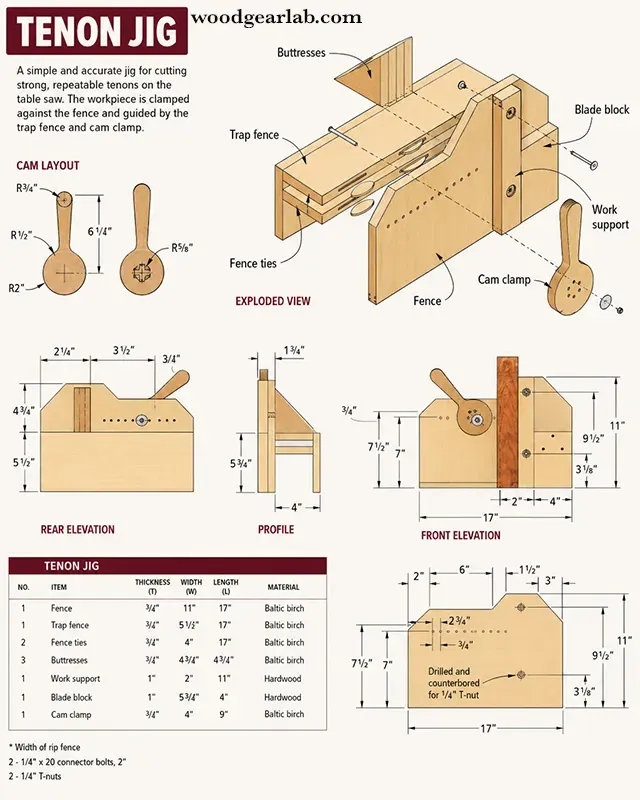
Cutting the cheeks of a tenon vertically by hand takes more patience and saw control than most of us have on a Tuesday night. But trying to do it on a table saw without a proper holding fixture is just asking for trouble. Balancing a narrow, two-foot-long piece of hardwood vertically against a standard miter gauge is a total nightmare—it flutters, the cut wanders, and if the stock binds against the blade, you’re looking at a nasty kickback.
A decent tenon jig fixes this basic safety and accuracy headache. It clamps your stock vertically at a dead 90-degree angle to the table, letting you slide the wood safely past the blade to get clean, flat shoulders and cheeks. Most woodworkers split into two camps here: spending money on a heavy commercial cast-iron jig, or building a shop-made plywood version that straddles the rip fence. Both setups can give you square tenons, but they handle the physics differently, and each forces you into a specific set of workshop tradeoffs.
Path 1: Heavy Cast-Iron Commercial Jigs
The standard commercial tenon jig—sold by brands like Delta, Grizzly, and Shop Fox—is a massive, heavy-duty fixture built from cast iron and steel. These units don’t touch your rip fence; instead, they ride directly inside your table saw’s standard 3/4-inch miter slot via a steel guide bar.
The primary advantage of these jigs comes down to pure mass. Weighing anywhere from 15 to 20 pounds, the heavy iron casting effectively dampens motor vibration and keeps the workpiece from chattering or fluttering when it hits the spinning blade teeth. That mass gives you an exceptionally clean surface finish on the tenon cheek.
Furthermore, these commercial jigs feature fine-threaded micro-adjustment screws. When you’re trying to dial in a tenon to fit a mortise perfectly, you don’t have to tap the jig with a mallet, overshoot, tap it back, and hope for the best. You just turn a knob to nudge the workpiece over a hair.
The Real-World Catch: These fixtures routinely run between $100 and $180. They are also incredibly awkward to store. In a small garage shop, a 20-pound lump of iron with random handles and clamping arms sticking out in every direction is an absolute pain to put away. It constantly catches on extension cords, eats up prime shelf space, and if you only use it a few times a year, it mostly just sits there gathering rust.
Additionally, commercial jigs require initial tuning. If your table saw’s miter slot has even a tiny bit of play or “slop,” the whole jig will rock side-to-side and ruin your cut’s squareness. You have to spend twenty minutes chasing down the play by adjusting internal expansion screws or shimming the bar before you can even make a clean test cut.
Path 2: Shop-Made Fence-Straddling Jigs
The alternative is the classic shop-made fence rider. Typically built from stable plywood scraps, this DIY solution is just a wooden channel designed to fit snugly over your table saw’s existing rip fence. Instead of riding in the miter slot, you slide the wooden fixture along the fence face to push your workpiece through the blade.
The obvious benefit here is cost. You can build a highly effective fence-riding jig on a Saturday morning using materials already sitting in your scrap bin. It requires zero financial investment, and because you build it yourself, you can customize the clamping surfaces, toggle clamps, or sacrificial backer blocks to fit whatever project you’re working on.
The Real-World Catch: Here’s the rub: this type of jig is only ever as straight as your rip fence. If your fence deflects when you lean into it, or if it sits even a hair out of parallel with the blade, the jig will mirror that error perfectly. You’ll wind up with tapered, sloppy tenons that ruin the fit of the joint.
Wood-on-metal friction can also give you a jerky, stuttering feed. Unlike a milled steel bar sliding smoothly in a miter slot, a plywood box riding over an aluminum or steel fence needs regular, heavy slathers of paste wax inside the channel to keep from sticking. If the jig hitches or stops mid-cut, the blade is going to leave ugly burn marks or deep gouges right on your tenon cheek.
Mechanical Tradeoffs at a Glance
| Feature / Factor | Commercial Cast-Iron Jig | Shop-Made Fence Rider |
|---|---|---|
| How it guides | Miter slot via adjustable steel bar. | Straddles and slides along the rip fence. |
| Weight & Stability | High mass (15–20 lbs); excellent dampening. | Low mass; prone to minor workpiece chatter. |
| Adjustability | Threaded micro-adjustments for precise tuning. | Manual positioning or using temporary shims. |
| What it relies on | Requires an accurate, non-sloppy miter slot. | Wholly dependent on perfect fence parallelism. |
| Storage & Cost | Bulky, heavy, expensive ($100–$180). | Compact, lightweight, virtually free to build. |
The Practical Verdict: How to Choose
Choosing between these two setups doesn’t come down to finding some ultimate winner. It really just depends on your specific saw, your shop space, and how many tenons you actually cut.
Scenario A: The Saturday Project
If you only build a couple of tables or cabinets a year, and your table saw features a reliable T-square fence that locks down dead parallel every single time, skip the commercial purchase. Spend a morning building a tight-fitting fence-straddling jig out of plywood. It will deliver clean joints without draining your wallet or permanently cluttering your limited shelf space.
Scenario B: High-Volume or Budget Saw Setups
If you are tackling a big project requiring dozens of identical, repeatable joints, or if your saw has a lightweight fence that flexes whenever you look at it wrong, buy the cast-iron jig. The fine-threaded micro-adjustments will save you an immense amount of setup frustration, and its tracking accuracy relies strictly on your miter slot, completely bypassing a finicky or uncooperative fence.