
Compact vs Jobsite Table Saw: What Actually Changes
INFO
Evidence Level: Manufacturer Specifications, Mechanical Analysis, and Owner Feedback.
Tool manufacturers often blur words like “portable,” “jobsite,” and “compact” in their marketing copy. But in the workshop, the difference between a compact table saw and a larger jobsite table saw represents a hard dividing line in mechanical capability.
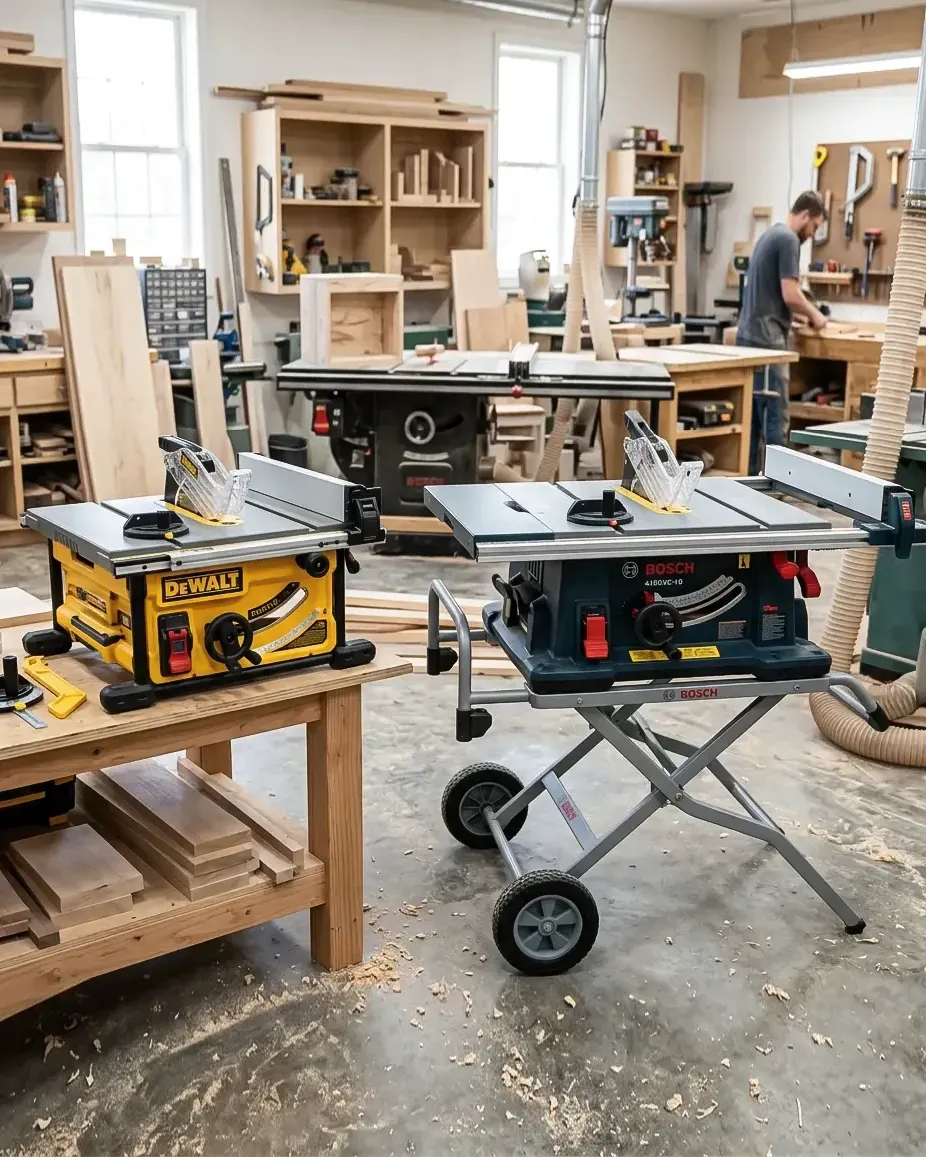
Technically, both fall under the umbrella category of portable table saws. However, when woodworkers compare the two, they are usually looking at a practical split: the ultra-lightweight, carry-around compacts (frequently using 8-1/4 inch blades) versus the heavier, 10-inch models mounted to rolling stands.
Understanding what actually changes between these two form factors helps clarify which limitations you can work around, and which ones are hardcoded into the machine’s geometry.
A Quick Specification Comparison
To see how these differences manifest on paper, here is how a standard compact saw compares to popular rolling-stand jobsite saws:
| Model Example | Blade | Rip Capacity | Depth at 90° | Depth at 45° | Dado Support | Weight / Stand |
|---|---|---|---|---|---|---|
| DeWalt DWE7485 | 8-1/4” | 24.5” right | 2.563” | 1.75” | No | ~50 lb (carry-style) |
| Bosch 4100XC-10 | 10” | 30” right | 3-1/8” | 2-1/4” | Model/manual dependent | 94 lb (w/ standard stand) |
| DeWalt DWE7491RS | 10” | 32-1/2” right | 3-1/8” | 2-1/4” | Yes, model-approved dado setup | 90 lb (w/ rolling stand) |
1. Blade Size and Cut Depth Limits
The most immediate physical difference is blade diameter. While some specialized compact saws, like the SawStop CTS, use 10-inch blades, many modern compact carry-style saws use 8-1/4-inch blades. Larger rolling-stand jobsite models commonly use 10-inch blades.
This smaller blade diameter helps manufacturers keep the saw package smaller, lighter, and easier to transport. However, mechanically, the smaller blade alters your maximum depth of cut.
- 10-Inch Jobsite Saws: Typically offer a maximum cut depth around 3-1/8 inches at 90 degrees, and 2-1/4 inches at 45 degrees.
- 8-1/4 Inch Compact Saws: Max out around 2-1/2 inches at 90 degrees. Their 45-degree cut depth often shrinks to around 1-3/4 inches.
While a 1.75-inch depth means an 8-1/4-inch compact saw can technically bevel-cut nominal 2-by lumber (which is 1.5 inches thick), it does so with much less margin than a 10-inch saw. The limitation becomes obvious with thicker stock, stacked material, or bevel cuts where blade exposure, guard clearance, and workpiece control become tighter.
2. Arbor Length and Dado Compatibility
If you plan to cut joinery, arbor length is a critical mechanical constraint.
Inside a compact table saw, the blade carriage and elevation/tilt assembly are packaged tightly to save space and weight. Consequently, the arbor shaft is kept as short as possible.
Because of this compact geometry, many small carry-style saws do not support a dado stack. There may not be enough arbor length, thread engagement, throat-plate clearance, or manufacturer-approved guarding support to secure the stack safely. Dado compatibility is not determined by blade diameter alone; even some 10-inch compacts, like the SawStop CTS, are not designed for dado stacks.
In contrast, many larger jobsite table saws use longer arbor assemblies and manufacturer-approved throat plates that allow dado stacks. When approved by the manufacturer, these saws can often safely run a 1/2-inch or 13/16-inch dado set for rapid joinery.
3. Table Space and Rip Capacity
Rip capacity is the distance between the blade and the fence when extended to its maximum limit.
- Many compact carry-style saws offer rip capacities in the low-to-mid 20-inch range.
- Many larger jobsite saws offer around 30 to 32.5 inches.
However, the raw spec sheet number hides the more important mechanical difference: table depth and infeed runway.
When you feed a board into a saw, the cast-aluminum table supports the wood before it hits the blade. Compact models have exceptionally short table depths. When cutting a wide piece of plywood on a compact saw, the sheet may reach the blade before you have much stable infeed support. The cut is possible, but the control margin is much smaller, especially without outfeed support, side support, or a helper, increasing the risk of twisting and kickback.
Larger portable models, like the Bosch 4100XC-10 or the DeWalt DWE7491RS, provide a larger surface area. This extra cast aluminum doesn’t just offer more runway; the added mass and wider stand can help reduce vibration and resist the leverage created by heavy sheet goods.
4. Weight, Portability, and Stability
The entire premise of a compact table saw is carry-style mobility. Saws like the DeWalt DWE7485 weigh around 50 pounds and use integrated roll-cages and handles meant for a “grab and go” carry up a flight of stairs, into an elevator, or loaded into the back of a small vehicle.
Standard 10-inch jobsite saws weigh significantly more—often 90 to 100 pounds when attached to their gravity-rise or scissor-lift stands. You do not carry them; you roll them like a hand truck.
The tradeoff for this extra weight is operational stability. A 90-pound saw on a wide-stanced rolling cart is mechanically anchored to the floor much better than a 50-pound saw on a small stand or temporary support. If a heavy sheet of 3/4-inch MDF catches slightly during a cut, a compact saw is prone to sliding. A heavier jobsite saw will generally hold its ground.
5. Motor Power and Drive Types
Despite the size differences, both classes rely almost exclusively on 15-amp universal brushed motors and direct-drive (or internal gear reduction) systems.
From a raw power perspective, they are surprisingly similar. However, their operating speeds differ based on blade geometry. Because rim speed (the speed at which the teeth actually strike the wood) is a product of both RPM and blade diameter, smaller blades often spin at higher no-load RPMs. For example, the 8-1/4-inch DWE7485 spins at 5,800 RPM, while the 10-inch Bosch 4100XC-10 spins at 3,650 RPM.
Both designs can rip 4/4 hardwoods when paired with a sharp, appropriate blade and a controlled feed rate. In practice, the limiting factor is often not only motor amperage, but blade sharpness, fence stiffness, feed pressure, and how well the workpiece is supported.
Making the Practical Choice
Choosing between the two depends entirely on what you cut, how you transport your tools, and what other tools you already own.
A compact table saw makes sense if:
- You are a flooring installer or trim carpenter who frequently moves between rooms or up stairs.
- Your primary materials are 1-by stock, trim, and small dimensional lumber.
- You are building a setup for a small garage where the saw must be stored on a shelf rather than taking up floor space.
- You already own a track saw to break down heavy sheet goods safely, reserving the table saw for smaller rips.
A larger jobsite table saw makes sense if:
- You are framing, building cabinets, or tackling general furniture projects where a stationary cabinet saw isn’t feasible.
- You need a larger table platform for ripping larger stock, processing sheet goods with support, or handling heavier workpieces.
- You want the ability to run dado stacks for joinery (model dependent).
- You have the floor space to store the saw vertically on its rolling stand.
Both tools are compromises compared to heavy cast-iron shop saws. The compact saw sacrifices capacity, table support, and joinery for ultimate mobility. The larger jobsite saw sacrifices easy vehicle loading and tight storage for a safer, more stable cutting platform.