
Riving Knife vs Splitter: What Changes Mechanically on a Table Saw
INFO
Evidence Level: This article is based on manufacturer safety documentation, table saw safety guidance, and mechanical analysis of blade carriage geometry. It does not claim hands-on testing of a specific saw model.
If you spend enough time looking at table saws, you will notice a distinct shift in how manufacturers handle the rear of the blade. Older models and traditional contractor saws rely on a stationary splitter. Modern saws use a true riving knife.
While both components are designed to keep the wood from pinching the rear of the blade, their mechanical implementations are entirely different. That difference directly impacts how the saw handles a workpiece and, more importantly, whether the user actually leaves the safety device on the machine.
To understand why the industry shifted, it helps to look at how these two devices differ in daily use.
| Feature | Riving Knife | Splitter |
|---|---|---|
| Mounting point | Moves with blade carriage/arbor support | Fixed to table, guard bracket, or throat plate |
| Blade height changes | Stays close to rear teeth | Gap changes as blade height changes |
| Bevel cuts | Usually tracks blade tilt | Depends on design; many fixed splitters do not track well |
| Non-through cuts | Possible on saws with an approved low-profile or adjustable riving knife | Usually removed for grooves, dados, rabbets |
| Main weakness | Must match blade kerf and be aligned | Fixed gap and removal friction |
| Best use case | Modern saws where the knife tracks blade height and tilt | Older saws or aftermarket zero-clearance insert systems |
The Mechanical Goal: Preventing the Pivot and the Pinch
The mechanics of table saw kickback generally involve two primary failures:
- Kerf Pinching: The internal stress of the wood releases as it is cut, causing the two halves of the board to clamp down on the back of the spinning blade.
- The Pivot: The workpiece wanders away from the fence, pivoting directly into the rear, ascending teeth of the blade, which lifts the board and throws it back at the operator.
Both a riving knife and a splitter act as a physical wedge to hold the cut open and block the wood from shifting into the rear teeth. However, their effectiveness in preventing the pivot depends entirely on their distance from the blade.
How a Splitter Works
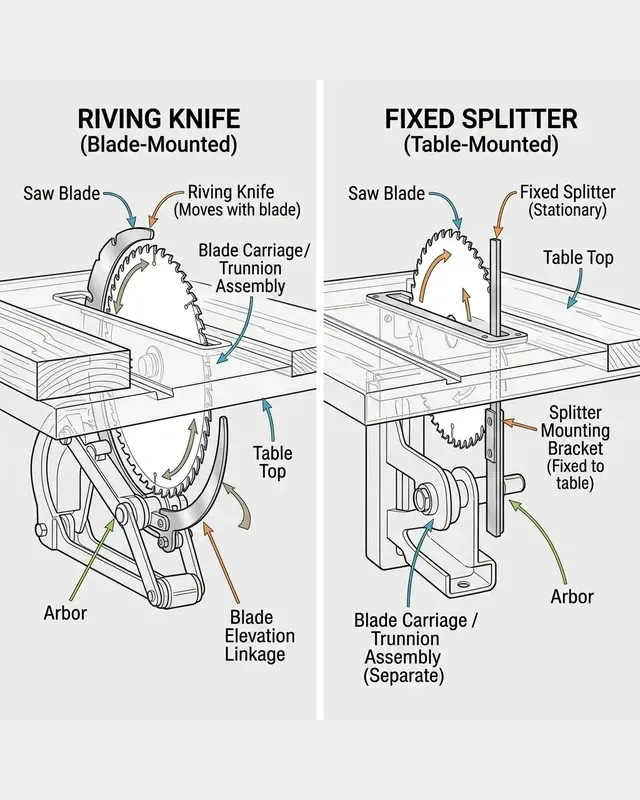
A traditional splitter is mounted to a fixed point on the saw. On older cabinet saws, it usually bolts to a bracket behind the trunnion assembly. On smaller or modified saws, it might be integrated directly into the throat plate.
Because the splitter is fixed in place, it does not move when you raise, lower, or tilt the blade. This creates two distinct mechanical limitations:
- Variable Proximity: When the blade is fully raised, a fixed splitter might sit relatively close to the back teeth. But as you lower the blade for thinner stock, the arc of the blade moves away from the stationary splitter. This creates a large, unprotected gap between the back of the blade and the front of the splitter. If a board shifts within that gap, it can still catch the rear teeth.
- Incompatibility with Non-Through Cuts: Because a standard fixed splitter sits higher than the blade when the blade is lowered, you cannot use it for grooves, dados, or rabbets. The wood will simply crash into the front of the splitter.
In practice, any safety device that is difficult to remove and reinstall creates workflow friction. That friction matters because users are more likely to leave a device off when it repeatedly gets in the way of common workshop cuts.
How a Riving Knife Works
A true riving knife is mounted to the blade carriage or arbor-support assembly, not to a fixed point on the table. Because it moves with the same mechanism that raises, lowers, and tilts the blade, its position relative to the rear teeth stays nearly constant.
Mechanically, this solves the two major limitations of the fixed splitter:
- Constant Proximity: Whether the blade is raised to its maximum height, lowered to cut a piece of 1/4-inch plywood, or tilted to 45 degrees, the riving knife remains at a constant radial distance from the teeth. Some standards and manufacturer instructions specify a very small clearance behind the blade—often within about 8 mm, with many setups using a 3–8 mm range. The exact value should always follow the saw manual. This tight clearance means there is almost no room for the wood to pivot before it hits the side of the knife.
- Non-Through Cut Capability: On saws that provide a low-profile or adjustable riving knife, the knife can sit below the top of the blade for some non-through cuts. This is not universal: the user should always follow the saw manual, and the full guard/riving-knife assembly should be restored for normal through cuts.
Because it rarely needs to be completely removed, a riving knife is far more likely to remain on the saw when a mistake happens.
Not a Complete Kickback Solution
A riving knife reduces two common kickback pathways, but it does not make a table saw kickback-proof. It cannot fix poor feed direction, a misaligned fence, warped stock, freehand cutting, or a cut that traps the workpiece between the blade and fence. It should be treated as one layer in the safety system, not the whole system.
A riving knife or splitter helps manage the rear of the blade, but the operator still needs proper push sticks and push blocks to control hand position, feed pressure, and workpiece stability during rip cuts.
Why Thickness Matching Matters
Regardless of whether a saw uses a riving knife or a splitter, the device only works if it is correctly sized for the blade.
A riving knife must be thicker than the blade body (the plate) but thinner than the cutting teeth. If you switch between thin-kerf and full-kerf table saw blades, you cannot necessarily use the same riving knife.
- If the knife is thinner than the blade plate, it may not hold the kerf open reliably enough to prevent the wood from closing on the rear of the blade.
- If it is thicker than the kerf, the workpiece can bind against the safety device mid-cut. Stop the cut safely and correct the blade/knife mismatch rather than forcing the stock forward.
Always check the blade body thickness, the cutting kerf width, and the stamped thickness on the side of your riving knife before making a cut.
Alignment and Fence Geometry
Even a perfectly sized riving knife is useless—and potentially dangerous—if it is not aligned properly.
If the riving knife is bent or bolted out of parallel with the blade, it can steer the wood away from the fence or bind in the cut. Proper blade alignment to the miter slot is the foundation of this setup. Once the blade is parallel, the riving knife or splitter must be dialed in to sit dead-center within the path of the teeth.
Furthermore, these safety devices do not replace the need for proper fence alignment. If a table saw fence toes inward at the back of the blade, it acts as a funnel, wedging the wood between the fence and the riving knife. The machine will labor, burn the wood, and significantly increase the risk of a severe kickback event.
Mechanically, the riving knife is a superior design due to its mounting geometry. By tracking with the arbor-support assembly, it provides consistent protection across blade heights and tilt angles, while significantly reducing the workflow friction that historically caused woodworkers to remove their safety gear.
FAQ
Is a riving knife better than a splitter? Mechanically, yes. A riving knife usually stays closer to the rear of the blade because it moves with the blade carriage. A fixed splitter can still help keep the kerf open, but its distance from the blade changes with blade height.
Can I use a riving knife with a thin-kerf blade? Only if the riving knife thickness matches the blade. The knife should be thicker than the blade plate but thinner than the cutting kerf. Always check the saw manual and the blade specifications.
Do I need a splitter if my saw does not have a riving knife? A properly aligned splitter is generally better than leaving the rear of the blade unprotected, but it must match the blade kerf and be installed according to the saw or splitter manufacturer’s instructions.