
Table Saw vs Miter Saw: Cutting Mechanics and Which to Buy First
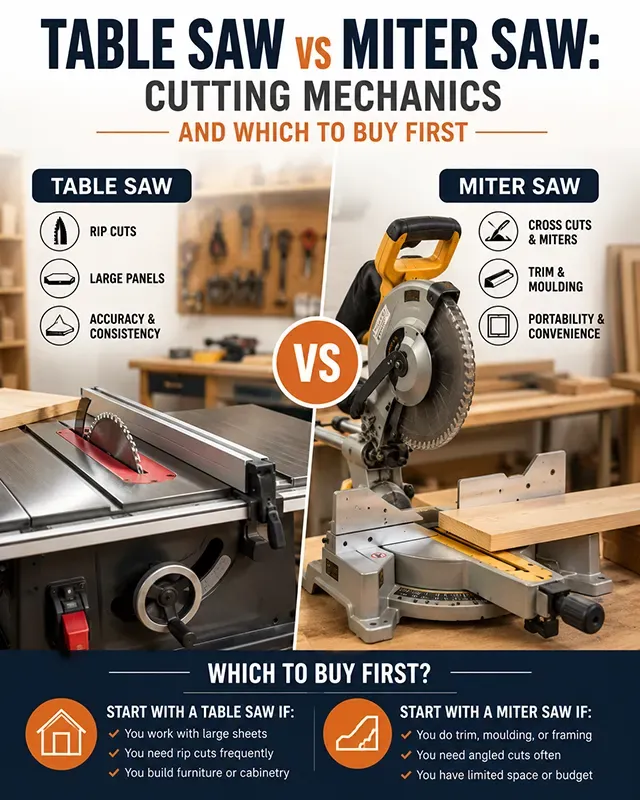
INFO
Evidence Level: Level 0 — Theory Lab
DANGER
Safety Note: This article explains cutting mechanics to help you make a purchasing decision, not operating instructions. Always follow your specific saw manual, use blade guards and riving knives where applicable, properly support long stock, keep hands out of the blade path, and never attempt cuts the tool is not designed to make.
When outfitting a new workshop, the choice between a table saw and a miter saw is one of the most common early decisions. While both tools spin a circular blade to cut wood, their mechanical operation dictates entirely different strengths.
Short Answer: Buy the table saw first for general woodworking, cabinetry, ripping boards to width, and repeatable dimensioning. Buy the miter saw first for trim work, framing, flooring, and home renovation where most cuts are crosscuts on long boards.
Best First Saw by Project Type
| Project Type | Best First Saw |
|---|---|
| General woodworking | Table saw |
| Cabinetry & furniture parts | Table saw |
| Plywood final sizing | Table saw, after rough breakdown with a circular saw or track saw |
| Trim, baseboard & crown | Miter saw |
| Framing & flooring | Miter saw |
Understanding whether to buy a table saw or miter saw requires looking past the spec sheets and focusing on how the mechanics of each tool dictate the way material is processed.
The Core Difference in Cutting Mechanics
The fundamental difference between these machines lies in the relationship between the blade and the workpiece.
The Table Saw: Fixed Blade, Moving Workpiece
On a table saw, the blade spins in a stationary position. The operator slides the wood across the table and past the blade. Because the workpiece moves past the blade, the practical cut length is limited more by stock support and shop space than by the diameter of the blade.
The Miter Saw: Fixed Workpiece, Moving Blade
On a miter saw, the wood is held stationary against a rigid fence. The operator pulls the spinning blade down (and often forward, on a sliding miter saw) through the wood. The length of the cut is strictly limited by the physical diameter of the blade and the length of the saw’s slide mechanism.
Breaking Down the Cuts
These differing mechanics mean each saw excels at entirely different operations.
Ripping Lumber (Table Saw Territory)
A rip cut is made parallel to the wood grain, typically to reduce the width of a long board.
Of these two tools, the table saw is the practical machine for ripping long boards. With proper infeed/outfeed support, an 8-foot board can be ripped on a table saw because the board travels continuously past the blade. A miter saw is not designed for rip cuts. Its fence, table, and blade travel are arranged for crosscuts and angled cuts, not for feeding a board lengthwise through the blade.
Crosscutting and Miters (Miter Saw Strengths)
A crosscut is made across the wood grain, typically to reduce the length of a board.
The miter saw is built around controlled crosscuts and angled cuts on linear stock. Because the wood remains stationary, cutting long, heavy boards—like a 12-foot 2x4—is more controlled when the work is properly supported and clamped. You mark the cut, register the board firmly against the fence, support or clamp it when needed, and lower the blade through the stock.
While a table saw can perform crosscuts using a miter gauge or a crosscut sled, maneuvering a heavy 12-foot board sideways across a table saw is awkward and often unsafe due to the leverage the overhanging board exerts.
Repeat Cuts
For repeated crosscuts on long boards, the miter saw is faster because the board stays supported in one direction and a stop block can be mounted on the left or right wing. For repeated parts that need exact width, parallel edges, or square cabinet components, the table saw’s fence and sled system usually creates the stronger reference system.
Breaking Down Sheet Goods
Between these two tools, the table saw is the sheet-goods tool. A miter saw cannot crosscut a 48-inch-wide sheet of plywood or MDF.
However, pushing a full 4x8 sheet through a table saw solo can be difficult and requires substantial infeed and outfeed support. In a small shop, many users still break full sheets down first with a circular saw or track saw, then use the table saw for final sizing.
Accuracy and Reference Systems
For final dimensioning, a well-tuned table saw with a rigid fence and a crosscut sled can be easier to build a repeatable reference system around. Inside a high-quality table saw, the arbor (the shaft holding the blade) is mounted to heavy cast-iron or steel trunnions beneath the table. Compared with a sliding saw head, the blade assembly has fewer exposed moving joints between the arbor and the table reference surface.
Sliding miter saws can be highly accurate, but their accuracy depends on a complex chain of moving joints: the pivot hinge, the bevel mechanism, the rotating table, the glide arms or rails, fence alignment, and detents. The downward pressure from your hand, combined with the lateral force of the blade entering the wood, tests the rigidity of all these joints simultaneously. Over time, maintaining absolute squareness on a sliding miter saw requires diligent calibration.
Dust Collection, Shop Space, and Safety
Beyond cutting, the way these tools exist in your workshop differs significantly.
Dust Collection
Miter saw dust collection is mechanically harder to control because the blade is exposed and the saw head moves through open air, ejecting sawdust in a wide radius. Some modern saws improve this with better shrouds or dual vacuum ports, but the dust path is still less contained than a table saw, where the blade is largely enclosed within a cabinet or shroud that directs debris downward.
Shop Space
A table saw requires dedicated infeed and outfeed space. To rip an 8-foot board comfortably, you need roughly the board’s length in front of and behind the blade, plus enough side clearance to control the stock.
A miter saw requires lateral space. It is typically mounted against a wall with long support wings extending to the left and right.
Safety Differences
The primary danger of a table saw is kickback—when the back teeth of the blade catch the wood and launch it back at the operator. Using a riving knife, a proper fence setup, and push sticks mitigates this risk.
Miter saws are less associated with the classic table-saw style of kickback, but they can still throw or shift material if the workpiece is unsupported, warped, round, or not held firmly against the fence.
Which Should You Buy First?
When deciding between a table saw or miter saw for a new shop, your choice should be dictated by the type of work you plan to do.
Buy a table saw first if:
- You plan to rip boards to width.
- You build cabinets, furniture, jigs, and shop fixtures.
- You need highly repeatable sizing for multiple identical parts.
- You work with plywood after rough breakdown.
- You have room for adequate infeed and outfeed support.
Buy a miter saw first if:
- You cut studs, trim, baseboards, crown molding, or flooring.
- You need fast, repeated crosscuts on long, linear boards.
- You work primarily on home renovation or jobsite tasks.
- You need portability and a space-saving wall-side setup.
- You rarely, if ever, need to rip lumber.
For fine furniture making and general woodworking, the table saw often becomes the mechanical center of the shop. The miter saw, when present, usually handles fast rough crosscuts on long stock before final sizing happens at the table saw.
FAQ
Can a table saw replace a miter saw? For small to medium stock, yes. With a well-built crosscut sled, a table saw can perform repeatable crosscuts and miters on small to medium stock. It struggles only when crosscutting very long, heavy boards.
Can a miter saw replace a table saw? No. A miter saw cannot perform rip cuts or cut wide sheet goods. It is a specialized tool for crosscutting and angled cuts on linear lumber.
Which is safer for beginners? Neither tool is inherently “safe,” but beginners often find the miter saw less intimidating because the workpiece remains stationary and the hands stay far away from the blade. Table saws require a deeper understanding of wood movement and kickback prevention to operate safely.
Can you cut plywood with a miter saw? You can cut narrow panels or plywood strips on a miter saw, limited by that saw’s listed crosscut capacity. Many 12-inch sliding saws fall roughly in the 12–14 inch range, though exact capacity varies by model. A miter saw cannot break down full 4x8 panels.
Do I need both eventually? Many woodworkers eventually own both for workflow efficiency. In a small shop, you can often delay buying a miter saw if you already have a table saw, a crosscut sled, and a circular saw or track saw for rough breakdown.