
CMT Combination Blade Review: Geometry, Kerf, and Fit
INFO
Evidence Level: Level 1 - Document Lab + Owner Feedback Synthesis.
The search for the perfect “leave it in the saw” blade usually leads to a 50-tooth combination blade. While dedicated rip blades (24T) and crosscut blades (80T) are mechanically superior for their specific tasks, constantly swapping them creates friction in a small shop workflow.
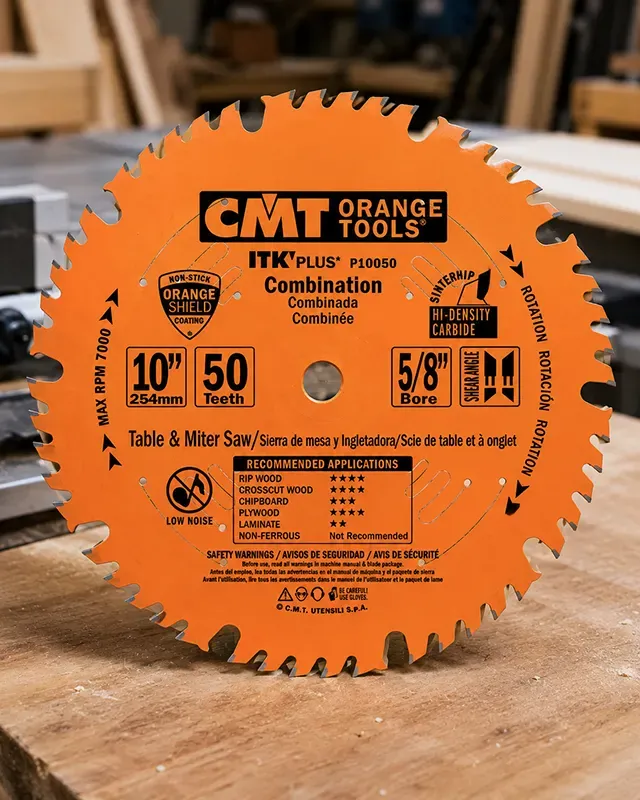
Based on specifications, design geometry, and recurring owner feedback, the CMT 10-inch 50T combination blade—especially the ITK XTreme (256.050.10) and ITK XPLUS (P10050) models—represents a practical compromise for small shops that prioritize fewer blade changes over task-specific optimization. For broader blade selection by cut type, see our guide to table saw blades by cut type.
Here is a breakdown of how the blade’s geometry works, what long-term owners report, and the mechanical limitations you should expect.
Mechanical Analysis: The 4+1 Geometry
The defining characteristic of a true combination blade is its tooth grouping. The CMT ITK 50T models utilize a 4+1 configuration. For related 50T combination-blade comparison points, see our Diablo D1050X review and Freud LU83R010 review.
Mechanically, this means the blade features groups of five teeth separated by deep gullets:
- Four ATB (Alternate Top Bevel) teeth: These teeth are angled on top, alternating left and right. They act like tiny knives, shearing across wood fibers to provide a clean crosscut with minimal tear-out.
- One FLAT raker: The fifth tooth in the group is flat across the top. Its job is to act like a chisel, clearing out the center of the kerf and plowing through the material.
This design is a deliberate mechanical compromise. An 80T ATB blade crosscuts better but burns wood during rip cuts because the gullets are too small to clear the long stringy chips produced when cutting with the grain. The CMT’s deep gullets in front of the flat raker provide the necessary volume to eject sawdust during a rip cut, preventing heat buildup.
The Value of the Flat-Bottom Kerf
One of the most frequently mentioned benefits in owner feedback regarding this specific ITK blade line is the flat-bottomed kerf it leaves behind.
Because ATB teeth are angled, a blade composed entirely of ATB teeth leaves a distinctive “bat-ear” or “V” shape at the bottom of a non-through cut. The flat raker on the CMT ITK blade is typically ground to pass through and plane the bottom of the cut flat.
For joinery, this is highly practical. If you are cutting tenons, half-laps, splines, or box joints on the table saw, a flat-bottom cut provides a flush mating surface for glue-ups without requiring a separate dado stack or hand-tool cleanup.
(Note: If you are looking at the CMT Industrial line, specifically model 215.050.10, be aware that it uses a 4 ATB + 1 TCG geometry rather than a flat raker, meaning it will not leave a perfectly flat bottom for joinery cuts.)
Kerf Width and Motor Load
CMT’s ITK 50T combination models sit in a thin-kerf-to-mid-thin range at about 0.102-inch kerf, mounted on a 0.071-inch plate.
Removing less material requires significantly less horsepower than a standard 0.125-inch full-kerf blade. If you are running a 15-amp jobsite saw or a 1.5 HP contractor saw, many thin-kerf blades are the mechanically correct choice. The 0.102-inch kerf can help the motor maintain RPM under load, especially compared with a wider full-kerf blade, which may translate to cleaner cuts and less burning when feed rate and alignment are controlled.
The inherent tradeoff with thinner plates is that they are more susceptible to deflection and vibration. CMT uses laser-cut expansion slots, dynamic balancing, and a tensioning ring on these 10-inch models; mechanically, those features are intended to reduce heat-related movement and improve stability, but this review does not include measured vibration testing.
For 3 HP cabinet saws, a thinner plate is generally unnecessary, as those motors have the torque to push full-kerf blades through thick hardwood without bogging down.
Coating and Maintenance
These blades are recognizable by their orange coating. CMT states that the Orange Shield coating is intended to reduce pitch buildup, lower friction, and protect against corrosion. In practice, this makes cleaning and maintenance a relevant part of the ownership experience rather than just a cosmetic detail.
To maintain cut quality, keeping the blade clean with standard citrus-based blade cleaners is critical. Additionally, ensuring your fence is properly aligned will prevent the back of the blade from binding, which is a primary cause of heat buildup and burning regardless of the coating used.
For a deeper maintenance breakdown, see our guide to table saw blade cleaning and resin buildup.
The Tradeoffs
No combination blade is perfect. While the CMT ITK 50T can cover many common small-shop cuts, owner feedback supports a clear pattern of limitations:
- Heavy Ripping: If you need to rip 8/4 (two-inch thick) hard maple, oak, or even thick pine, this blade will likely struggle compared to dedicated rip blades. Some owner feedback mentions slower ripping, motor bog-down, or burning when pushing thicker stock.
- Fragile Veneers: While it crosscuts solid wood cleanly, cutting brittle melamine or thin-veneered plywood may result in minor chip-out on the bottom face. A high-tooth-count Hi-ATB blade remains the correct tool for delicate sheet goods.
Who Should Consider It
The CMT 50T ITK combination blade makes the most sense for the small shop owner or serious hobbyist who works primarily with solid wood (4/4 to 6/4 thickness) and wants to avoid changing blades between ripping and crosscutting. For 1.5 HP saw owners, the 0.102-inch kerf is an excellent match for the motor, offering a solid balance of cut quality and the added utility of flat-bottom joinery cuts.
Who Should Skip It
Production shops that spend hours breaking down sheet goods or ripping thick rough lumber should skip the combination approach entirely. In those environments, the time saved by not changing blades is lost to slower feed rates and inferior cut quality compared to task-specific tooling.